

Synthetic data promises research that is faster, cheaper, and more accessible, but the evidence on efficacy is hard to read. For a business ready to make decisions based on synthetic data, that is the first problem to solve.
The accuracy numbers in vendor decks are real, and so are the studies showing digital twins wrong about a quarter of the time. Both can be true because no one is measuring with the same yardstick.
So, GBK Collective is skipping the hype and the hand-wringing and doing what researchers do when the evidence is mixed: writing down the questions, picking the measures, and running the tests. We’re asking and answering the top questions businesses are asking and unpacking what it all means with Professor Olivier Toubia of Columbia Business School, a lead researcher in synthetic data and a member of GBK’s Academic Collective across a new three article series. Here’s a sneak peek:
1. "How accurate is it?" is only a part of the equation
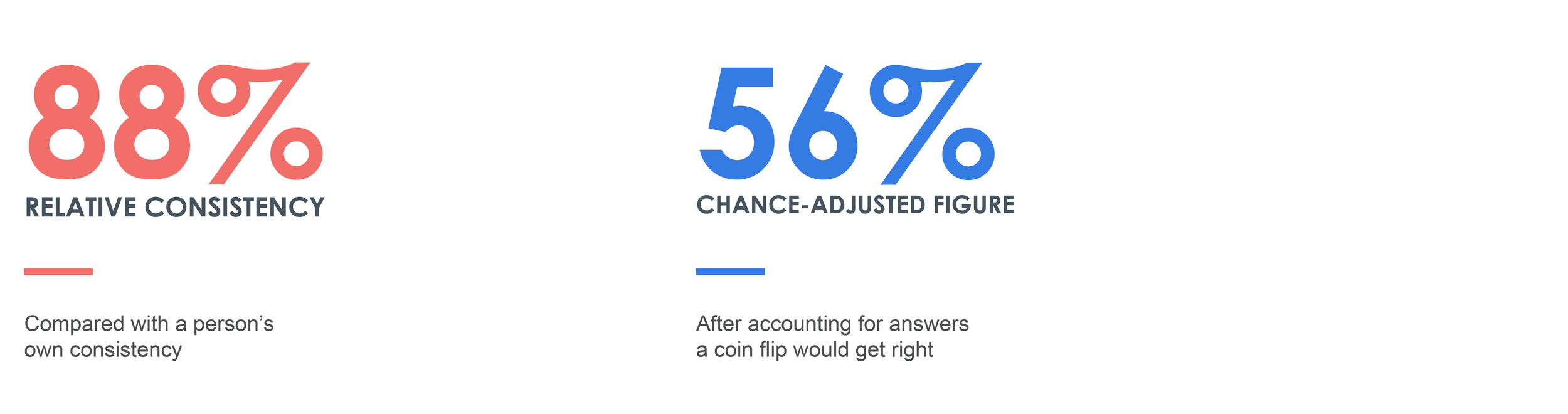
A digital twin is an AI model built from one real person’s interviews or survey answers, so it can be asked new questions on that person’s behalf. A twin’s accuracy score decides whether a team trusts it with a decision, and that score depends heavily on who is keeping it. One widely cited study puts twins at 88% of a person’s own consistency. Take out the answers a coin flip would get right and the figure is 56%. Another found the same simulation agreeing with real people anywhere from weakly to strongly, depending on setup choices.
Our take is that the question needs replacing. It treats a twin as a stand-in for a survey, and much of the value is in work that was never practical before, like screening thousands of campaign ideas where a team used to test only a handful that were manageable for respondents and practical given rapid timelines. Generative AI is good at generating content and can expand the research workflow rather than replacing parts of it. The better question is whether a twin is improving the process for the decision in front of you.
As synthetic data earns a place in the research toolkit, businesses still need a way to judge what comes back. That judgment rests on a few things: what the data was built from, how far your question sits from that material, the methodology to build the twins, how fresh it is, and what being wrong would cost. Buyers need a short set of questions and tests for synthetic data, and an accuracy bar that matches the stakes of the decision. A shared synthetic data standard would help everyone, and the Marketing Science Institute has a synthetic data initiative under way to do just that. In the meantime, GBK is asking these questions of vendors, testing them within our Academic Collective, and building evidence that a shared standard can draw on.
2. What's next for digital twins: the stated, the modeled and the gut
Most marketing is judged in seconds. A shopper glances at a mailer and reacts reflexively. However, a twin shown the same mailer writes a thoughtful paragraph based on LLM priors and scores of training data. Today's twins are built from what people say, so they are good at explaining but weak at reacting, and reactions are what most concept, ad, and message tests are trying to capture. Research GBK ran with Columbia found that longer, richer interviews did not close the gap.

What if twins were built with a methodology that resembles the way people decide? First comes a score on how much something matters to this person, then a second stage that uses that score to produce a commensurate response: a shrug for the mailer, real deliberation for a big purchase, and thoughtful reasoning when asked to expound on why. A new kind of AI model that returns a quick probability with no prose introduces a potential to mimic this first step and signals where AI will continue to evolve, and a short choice exercise in the interview can ground the twin in how a person chooses as well as what they say.
The payoff would be twins that react more like customers, potentially at lower cost, because most stimuli never need the full treatment.
3. A conversation with Professor Olivier Toubia, Columbia Business School

The loudest voices on synthetic data are selling it, and a business needs a read from someone who measures it. Professor Olivier Toubia of Columbia Business School is the senior author of the study considered the most comprehensive test of digital twins to date. One thing his team learned: the study showed that twins were consistently more positive about technology than the people they were built from, so a twin panel can make a new AI feature look more welcome than it is. If you are using twins, or about to, understanding these nuances and distortions are critical.
We are sitting down with him to ask what he is working on now, what companies are getting right and wrong, what a buyer should ask before trusting a twin, and where this will be in two years.
This is GBK's Academic Collective at work: clients' hardest questions, put to the researchers producing the evidence.
The research continues.
Stay tuned for upcoming articles on each of the topics above. To learn more, reach out to Jared Piraneo, EVP of AI Strategy at GBK Collective, or check out some of our recent Thought Leadership and our Academic Expert Collective.